Description
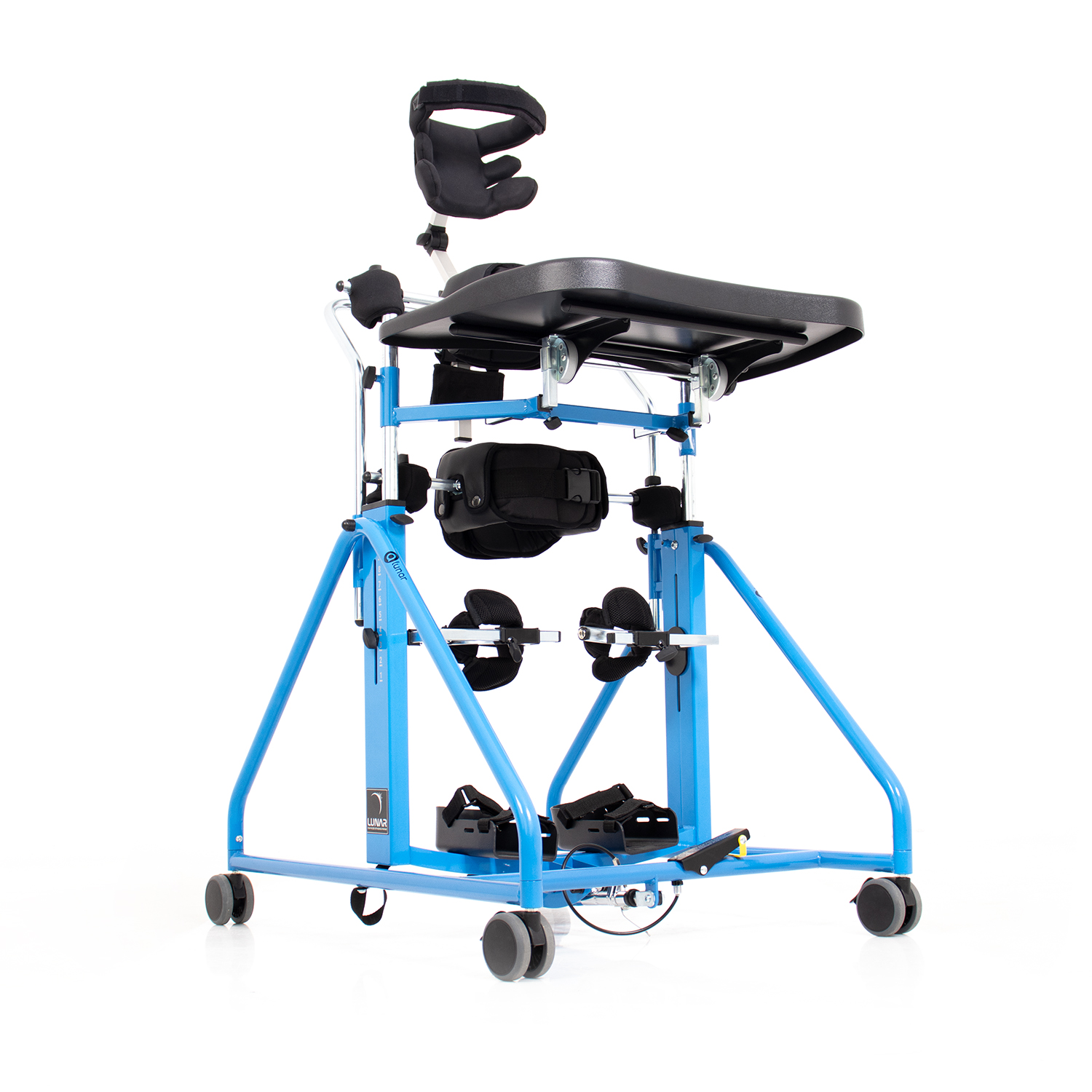
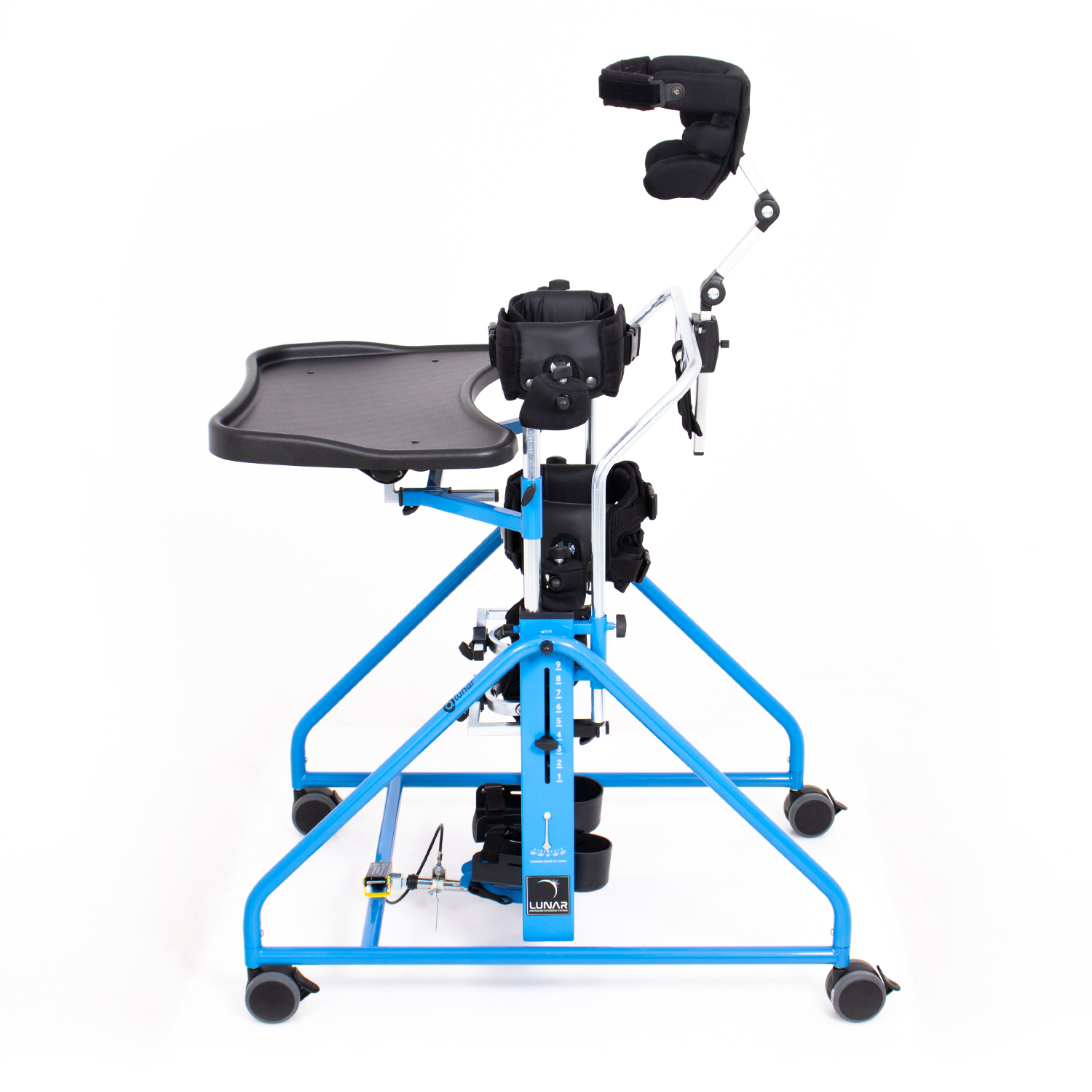
LUNAR® is an innovative standing frame that enables standing and maintaining an upright position, thereby supporting therapy and rehabilitation. It has been designed with full safety and high comfort in mind for both the user and caregivers or medical staff, thanks to the use of modern solutions such as smooth and stepless adjustment of stabilizing elements for the user. The product provides extensive functionality while maintaining easy and intuitive operation.
Prone/Supine Standing:
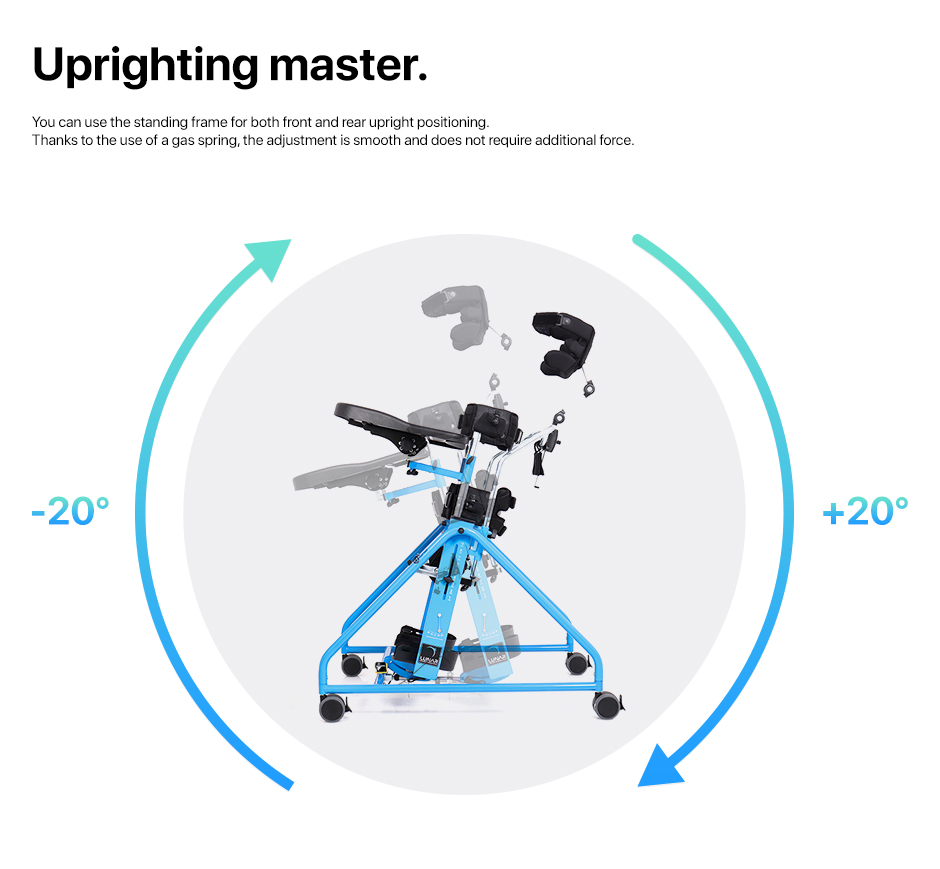
LUNAR® allows both prone and supine standing, which significantly impacts muscle tone normalization and balance. This feature enables user position adjustment, providing therapists with greater control over the therapeutic process.
Lower Limb Extension:
Supporting proper posture and joint stability is a key role of LUNAR®. By enabling muscle stretching, the standing frame prevents contractures, dislocations, and hip joint dysplasia, supporting the overall condition of the user.
Knee Joint Stabilization:
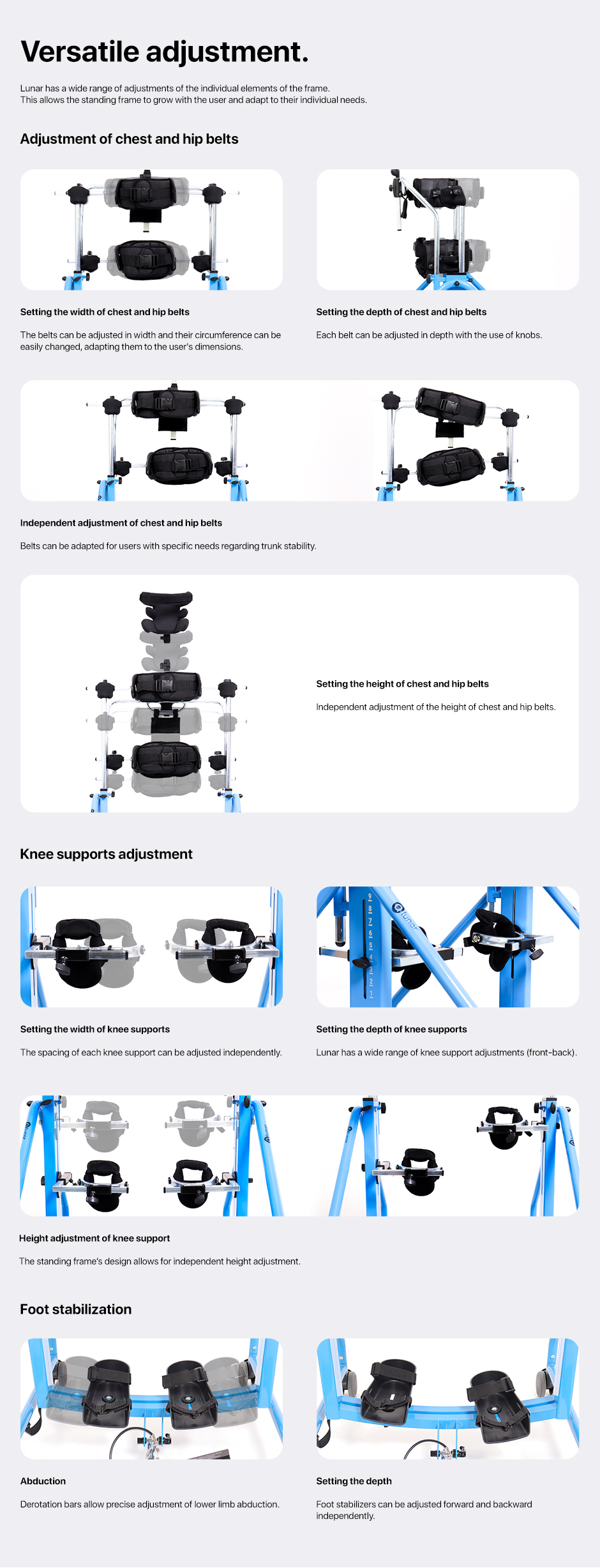
Equipped with knee pads with independent depth, height, and width adjustment, LUNAR® offers optimal knee joint stabilization. The use of smooth and stepless adjustment allows for individual and comfortable knee protection.
Precise Trunk and Pelvic Adjustment:
With independently adjustable hip and chest belts, LUNAR® allows for trunk adjustment in terms of up-down, side, and rotation. This precise adjustment adapts to the anatomical and biomechanical characteristics of the user, contributing to improved balance and motor function.
Special features
- Smooth and Stepless Adjustment: The product components work together with reduced resistance.
- Increased Durability: Thanks to the smooth and stepless adjustment, the operation of the components is much smoother, resulting in minimizing undesired micro-movements of regulated elements.
- Quiet Operation: Operation between smoothly adjustable elements is significantly quieter compared to standard solutions.
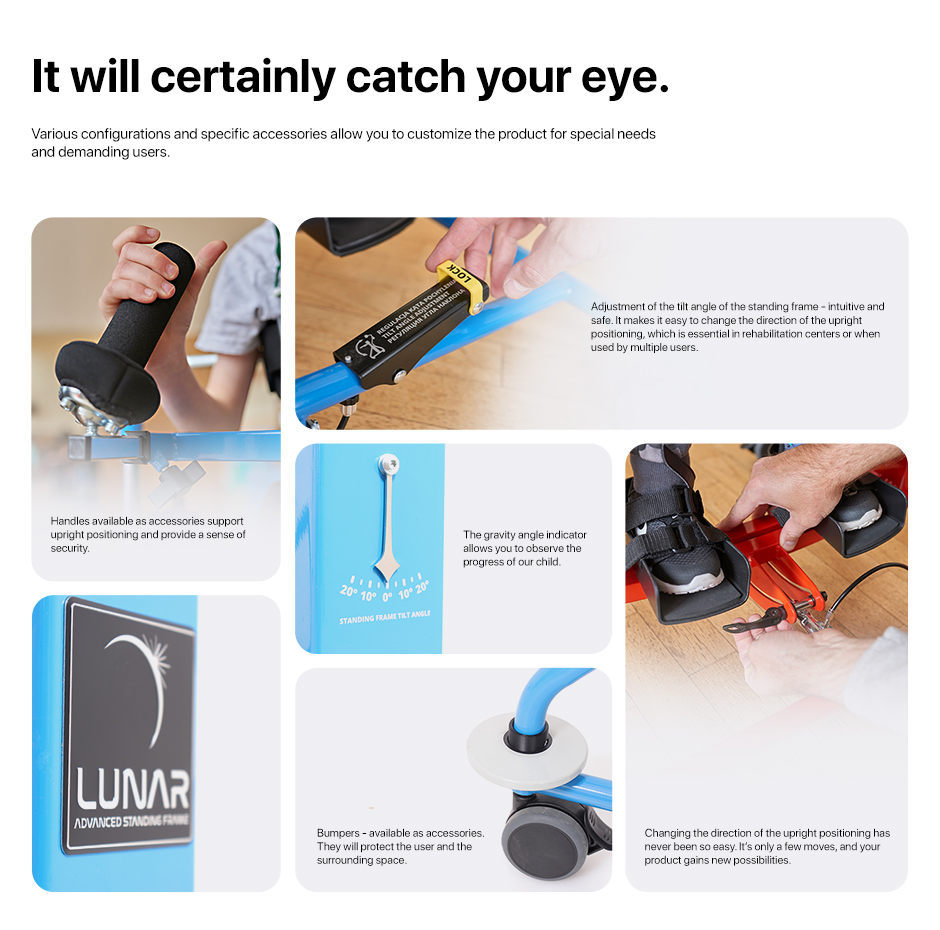
- Stable: The stable base is equipped with wheels with independent brakes, allowing for easy movement of the standing frame between rooms.
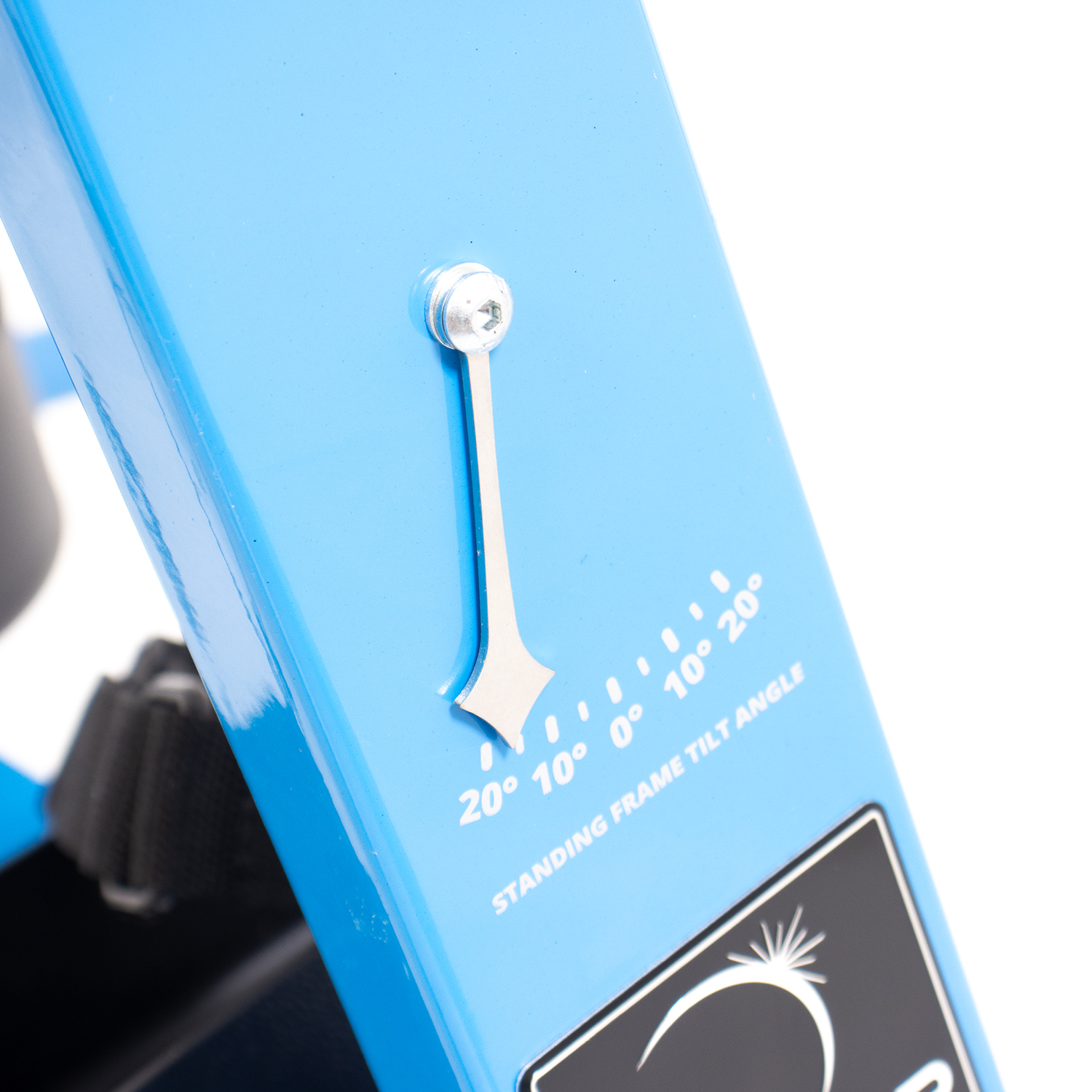
- Ergonomic: The use of ergonomic knobs and position adjuster makes the standing frame extremely simple and intuitive to operate.
- Mobile: The standing frame is lightweight and compact, allowing for use in small spaces.
- 24-Month Warranty: We offer 24-month warranty on the product. We also provide after sales service.
Indications & Contraindications
INDICATIONS
It is recommended in the following cases:
- Cerebral palsy (CP) – various types and forms.
- Brain and spinal cord injuries of various etiologies with limb paresis, severe balance disturbances, and coordination impairments.
- Demyelinating diseases (multiple sclerosis – MS, amyotrophic lateral sclerosis – ALS, and others).
- Meningocele.
- Muscle diseases with paresis and paralysis (including dystrophy, myasthenia gravis, polymyositis).
- Genetic syndromes with limb paresis.
- Degenerative and metabolic diseases of the nervous system.
- Degenerative and rheumatic joint diseases.
- Other diseases with limb paresis, paralysis, and musculoskeletal impairments.
- After injuries, following traumatic brain injuries or spinal cord injuries with limb paresis and paralysis, particularly with quadriplegia (as part of the rehabilitation process or as permanent orthopedic support).
CONTRAINDICATIONS
During standing process, the person being stood must be observed. In case of side effects such as paleness, sweating, or fainting, joint overloading and resulting body deformations, the therapy should be stopped. Further steps should be consulted with a specialist doctor or physiotherapist who prescribed the aid.
Absolute contraindication to standing therapy is the critical condition of the user.
Relative contraindications to standing therapy:
- Resting arterial hypertension above 200/110 mmHg, pulmonary hypertension, heart rhythm disorders, unstable asthma, unstable metabolic disorders, moderate stage of heart valve disease.
- Any condition, such as healing fracture or severe osteoporosis, that prevents weight-bearing in any way.
- Fracture with incomplete healing, unless approved by a doctor.
- Postoperative joint load restrictions.
- Pain associated with standing in the stander (caused by dislocation or hip dislocation, excessive stretching of soft tissues, excessive pressure). Dislocation or dislocation of the hip joint without pain is not a contraindication.
People with significant flexion in the hip or knee joints, as well as with ankle joint contractures, may not be able to use the stander. Caution should be taken to ensure that the position in the device does not cause excessive pressure or stretching of the diseased areas of the body. In such cases, standing therapy may be contraindicated until a greater range of motion is achieved in the contracted joints.
For individuals with impaired circulatory system (resting arterial hypertension above 200/110 mmHg, pulmonary hypertension, heart rhythm disorders, moderate stage of heart valve disease); respiratory system (unstable asthma) and unstable metabolic disorders, close monitoring of the user during standing position is necessary to prevent serious complications. This includes particularly monitoring blood pressure, heart rate, and any symptoms of orthostatic hypertension.
Sizes
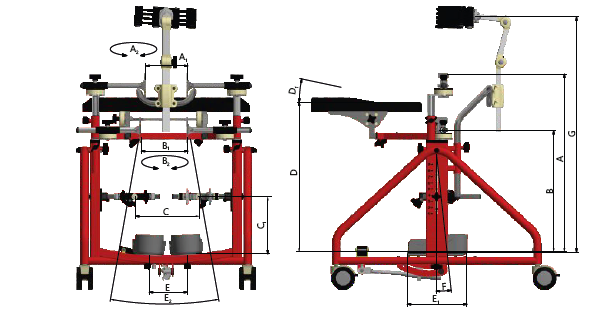
| Symbol |
Measurement |
Unit |
Size 1 |
Size 2 |
Size 3 |
| W |
indicative user height* |
[cm] |
75 – 100 |
95 – 125 |
120 – 150 |
| A |
chest belt height** |
[cm] |
57 – 79 |
69 – 91 |
82 – 108 |
| B |
pelvic belt height** |
[cm] |
39 – 62 |
50 – 70 |
62 – 82 |
| A1/B1 |
chest / pelvic belt width |
[cm] |
14 – 22 |
16 – 22 |
20 – 26 |
| A2/B2 |
chest / pelvic belt parimeter |
[cm] |
55 – 68 |
60 – 73 |
67 – 85 |
| C |
knee supports width |
[cm] |
14 – 24 |
16 – 28 |
16 – 30 |
| C1 |
knee supports height** |
[cm] |
12 – 28 |
24 – 40 |
32 – 48 |
| D |
tray height** |
[cm] |
48 – 75 |
59 – 87 |
73 – 104 |
| D1 |
tray tilt angle |
[°] |
-20 – 20 |
-15 – 15 |
-10 – 10 |
| E |
footer spacing |
[cm] |
13 – 34 |
13 – 36 |
13 – 42 |
| E1 |
footer length |
[cm] |
19 |
23 |
23 |
| E2 |
lower limbs spacing |
[°] |
for user 75 cm – 50
for user 100 cm – 30 |
for user 95 cm – 40
for user 125 cm – 30 |
for user 125 cm – 35
for user 150 cm – 25 |
| F |
tilt angle |
[°] |
-20 – 0
0 – 20 |
-15 – 0
0 – 15 |
-10 – 0
0 – 10 |
| G |
headrest height |
[cm] |
70 – 98 |
86 – 113 |
105 – 140 |
|
max. user weight |
[kg] |
35 |
45 |
55 |
Note: Measurement tolerance range is +/- 1 cm / ½ in.
* Height cannot be the main parameter while choosing the product size.
** Height measured from the footers.
Weight and dimensions
| Measurement |
Unit |
Size 1 |
Size 2 |
Size 3 |
| width |
[cm] |
59 |
64 |
69 |
| length |
[cm] |
76 – 83 |
86 – 93 |
95 – 102 |
| height |
[cm] |
61 – 881)
70 – 922)
83 – 1113) |
71 – 1001)
83 – 1052)
98 – 1263) |
84 – 1151)
93 – 1192)
116 – 1513) |
| weight |
[kg] |
171)
18,12)
19,73) |
18,61)
19,82)
21,63) |
21,21)
22,62)
24,73) |
Note: Measurement tolerance range is +/- 1 cm / ½ in.
Note: Approximate values, depending on the product configuration.
1) For configuration I.
2) For configuration II.
3) For configuration III.